Thursday, December 5, 2013

The Seventh-Day Adventist Church

This article was published in the June 26, 2013 issue of The Polk County Pulse.  The article was written by Michael Reisig.  I sat down for an interview with him last week.

The mission of the Seventh-Day Adventist Church on Fairgrounds Road in Mena is to make disciples of all the people, communicating the everlasting gospel in the context of the three angels' messages of Revelation 14:6-12, leading them to accept Jesus as their personal Savior, discipling them to serve Him, and preparing them for His soon coming.  The Seventh-Day Adventists believe particularly in the soon coming of Jesus Christ and that is essential to their philosophy. The history of the area church goes back over a century, to 1905, when it was first organized by Elder L. W. Feltner.

In 1957, the congregation purchased the old school building in Dallas Valley.  The church met there until 1990 when they moved to the current church building on Fairgrounds Road.  The construction was funded entirely by the congregation and was debt free at its completion.

The church has a pastor that serves several Seventh Day churches in the area, but the Head Elder of the church is Richie Lawry, who has been with the organization for over three decades.  Lawry grew up in Colorado, graduating from high school in 1973 and becoming involved in the auto repair industry.  He met his wife, Regina, in high school and they were married in 1975.

"My dad came to Mena to visit a friend and he liked it so much he ended up buying two houses," Lawry recalled.  "My wife and I visited here and liked it just as well so we moved here in 1981.  Shortly after settling here, I became involved with the Seventh-Day Adventist Church and have been with them ever since."

Within a few years Lawry became an elder and went on to become head elder in 2000.  "To me, and to us here, it is the worshiping of Jesus on the 7th day that binds us," Lawry explained.  "Jesus, when he attended the synagogue, went on the Sabbath.  I want to live my life by the 10 Commandments, and one of those is to worship God on the seventh day.  We are also a church that has a passion for missions and helping the community.  We have a soup kitchen each Tuesday from 11 a.m. to 2 p.m., and anyone and everyone is welcome to come by for a free meal.  We generally provide meals for over 130 people.

"We have also funded and helped build a church in San Pedro, Belize, and funded the building materials for 29 churches in Africa," Lawry continued.  "We work with a company that offers kits to build open-walled churches that can be framed in if desired.  The kits are delivered in large boxes and can be assembled in a day."

Lawry added that his is an extremely generous congregation, willing to help and to give, and although they are not generally a wealthy people, they always give from their hearts.

"If you'd like to see what the Seventh-Day Adventist philosophy is all about, we'd love to have you come out and visit with us and meet the people of our congregation," Lawry added.  "We meet on Saturday mornings from 9:30 a.m. to 12:00 p.m., which includes a Bible study period and a church service at 11 a.m., and as of July 1 we will be meeting on Wednesday evenings from 6:30 p.m. to 7:30 p.m. studying books of the Bible.

Your GPS


When my son was a young boy he belonged to the DeQueen Pioneers Pathfinder Club, and I was a Pathfinder leader.  One weekend I took the Pathfinders on a backpacking trip.  We left in the evening and headed to Alexandria, Louisiana. We made it to Alexandria at about midnight.  There I took the eastbound exit off of the interstate instead of the westbound exit.  I wandered around Alexandria for an hour trying to find the right road.  By the time we found the campground it was 1:30 and we still had to pitch our tents.

I would have loved to have some way of knowing the right way to go to reach the campground.  I'm not the only one who has wished for such a device.  For centuries, navigators and explorers have longed for a system that would enable them to locate their position on the globe with the accuracy necessary to avoid tragedy and to reach their intended destinations.

The answer came about because of the Cold War.  U.S. scientists began working on the GPS system because of an Air Force requirement for a guidance system to be used with a proposed ICBM that would travel on a railroad system. On June 26, 1993, the U.S. Air Force launched a satellite into orbit, completing a network of 24 satellites known as the Global Positioning System, or GPS.

This satellite navigation system was intended for military use and therefore the signals were scrambled, limiting accuracy for civilian use.  On May 1, 2000, President Clinton announced that this scrambling would be turned off. Civilians were then able to use the GPS signals.  Soon there were accurate automotive navigation systems available.  Now smart phones come with GPS capability.

I like using my GPS; we have named her Tink. She tells me when to turn. She tells me what lane to be in. On our last trip to Houston to see our son she took us a new way and saved us half an hour.

So now that I have Tink to guide me, I never get lost.  I always know where to go.  Except---

When we first got Tink we were going to Shady Lake. Now I have been to Shady Lake a number of times, and I know how to get there. When Tink wanted me to turn off of my normal route I decided to see where she would take us. She took us on an adventure. She guided us to Shady Lake over forest service roads that hadn't been traveled on in a long time. There was grass growing in the road. We arrived safely at Shady Lake about an hour later than if we had traveled our normal route.

A couple of weeks ago we went to Dierks Lake to see our granddaughters compete in the Pathfinder Adventurer Cardboard Boat Race. Tink wanted us to leave the highway and travel across dirt roads. We declined. On our way home I was curious as to where she wanted to take us so we followed her advice. After travelling on forest service roads we were within just a few miles of the highway when we came to the Cossatot River bridge that was impassable because there was three feet of water flowing over it.

We had to turn around and go all the way back to Dierks Lake so we could take the paved roads. On our way back to the lake we followed Tink and were stymied three different times by locked gates across the roads.  After an hour we finally made our way back.

Sometimes exploring a new road can be quite an adventure. When you are traveling a rural Arkansas road you just don’t know where you will end up.  Sometimes even a GPS doesn't help.

Have you taken any wrong turns in your life?  Have you been on any wrong roads?  How do you know which road to take?

In Psalms 25:4, the Bible says, "Show me the path where I should walk, O LORD; point out the right road for me to follow".

That sounds like a GPS doesn't it. God will point out the right road for us to follow.  You can trust him.  You might not always be able to trust your GPS, but you can always trust God.  No matter how knowledgeable you are, you aren't the best choice as navigator. Proverbs 14:12 tells us that, "there is a way that seems right to a man, but its end is the way of death".

The whole point of being a Christian is to have a knowledgeable navigator to guide us through this life to our eternal destination. Why would we decide not to listen to the best guide there is and use our own judgment instead?

Solomon explained it very well in Proverbs 20:24   “how can we understand the road we travel? It is the LORD who directs our steps.

The only reliable GPS for our spiritual life is God’s word.  The Bible gives us direction.  So many Christians I meet seem to want more than the Bible.  The old reliable Bible isn't enough for them and they want something new. Psalms 119:105 states, "Your word is a lamp to my feet and a light to my path".  If David and Solomon understood that it was God’s Word that directs our steps why should we feel that there is not enough information in the Bible and feel the need to supplement it?

I hope that you know where you are going. Have you studied the map? Do you have your spiritual GPS? Do you use it?

I hope that you and I will be able to say what David said in Psalms 73:23-26. “Yet I still belong to you; you are holding my right hand. You will keep on guiding me with your counsel, leading me to a glorious destiny. I have no one in heaven but you; I desire you more than anything on earth. My health may fail, and my spirit may grow weak, but God remains the strength of my heart; he is mine forever”.

Back Roads

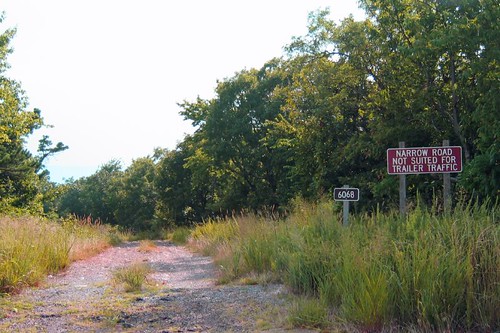
Not Suited For Trailer Traffic

I love driving on the back roads in western Arkansas. I love the scenery. I love the adventure. I love to just take off and explore new roads. When I see a road I always wonder where it goes.  Just last weekend we had an adventure on the back roads of Arkansas.

On our way back home from Dierks Lake, we took a "shortcut" over gravel mountain roads.  Within just a few miles of the highway we came to the Cossatot River bridge that was impassable because there was three feet of water flowing over it.  We had to turn around and go all the way back to Dierks Lake so we could take the paved roads. On our way back to the lake we followed our GPS and were stymied three different times by locked gates across the roads.  After an hour we finally made our way back.

Sometimes exploring a new road can be quite an adventure. When you are traveling a rural Arkansas road you just don’t know where you will end up.

In the fall of 2006 America was transfixed with the story of James Kim. He was traveling home from Portland, Oregon to San Francisco, California with his wife and 2 children. They took a wrong turn onto a logging road in bad weather. The snow became too deep to travel, and they became stranded.

After several days Mr. Kim set out on foot to look for help. He believed the nearest town was located four miles away. The distance to the town was actually 13 miles. He promised his family that he would turn back at 1 p.m. if he failed to find anyone, but he did not. Kati Kim and her two children were found alive when a search helicopter was led to the scene after seeing human footprints in the snow. The three were then rescued, and airlifted out of the area.

Soon after the rescue of Kati Kim and her children, search and rescue teams followed James Kim's footprints back along the road for about 10 miles where his footprints left the road and led into the heavily wooded Big Windy Creek drainage area. James Kim's body was found in Big Windy Creek. He had walked 16 miles looking for help.

Although Mr. Kim had walked 16 miles, he was found about four miles from his vehicle, and about one mile from Black Bar Lodge, a boating outpost. Though it was vacant at the time, it was stocked with food items. What a tragic story!

In Proverbs 14:12 the Bible tells us “There is a way that seems right to a man, but its end is the way of death”. When the Kim family decided to go down that logging road, they had no idea that the road was impassable. Had they known about it, I’m sure they wouldn’t have taken that path. It was supposed be a short cut, but only led them to tragedy.

What about the road you are on in your life? Have you taken any wrong turns in your life? Have you been on any wrong roads? How do you know which road to take?

In Psalms 25:4,8-10 the Bible tells us” Show me the path where I should walk, O LORD; point out the right road for me to follow. The LORD is good and does what is right; he shows the proper path to those who go astray. He leads the humble in what is right, teaching them his way. The LORD leads with unfailing love and faithfulness all those who keep his covenant and obey his decrees.

God has promised to be our guide. He will point out the right road for us to follow. As I have discussed spiritual things with people I have heard the following analogy several times. “You see it your way I see it my way, but there are many roads all going to the same place.”

Jesus has an answer for that way of thinking. We find his words in Matthew 7:13,14. “You can enter God’s Kingdom only through the narrow gate. The highway that leads to destruction is broad, and its gate is wide for the many who choose the easy way. But the gateway to life is narrow, and the road is difficult, and only a few ever find it”. You know from experience that all roads don’t lead to your destination. I’m sure that you have been on a road that didn’t take you where you thought it would. James Kim found out this truth in a tragic way.

One of the last songs that George Harrison recorded was a song titled “Any Road”. The chorus of the song says “If you don't know where you're going any road will take you there”. His words are very true. They describe the kind of roads that I like to explore. I like to drive on them because I don’t know where I’m going. I like to just take off and explore new roads. When I see a road I always wonder where it goes. A number of times I have been completely lost, but eventually I made it home. It can be fun not knowing where you are going.

While it can be fun to explore unknown roads on a Sunday afternoon drive, it’s not a good plan in our spiritual lives. We should know where we are going. We should all have the same destination in mind.

I hope that you know where you are going. Jesus told us that not just any road would take us there. Have you found the road that leads to life? Have you studied the map?

I hope that you and I will be able to say what David said in Psalms 73:23-26. “Yet I still belong to you; you are holding my right hand. You will keep on guiding me with your counsel, leading me to a glorious destiny. I have no one in heaven but you; I desire you more than anything on earth. My health may fail, and my spirit may grow weak, but God remains the strength of my heart; he is mine forever.

Road of Death


.  
Pastor Martinez and I attended high school together at Campion Academy in Loveland, Colorado. He recently wrote an article about a personal experience that I found very interesting. I asked him if I could use it on my blog and he graciously agreed.

The Road Of Death
by Pastor Robert J. Martinez Sr. 

This is a true story. It happened to me on Oct. 13, 1987. My family and I were missionaries in La Paz, Bolivia, where I served as youth director for the Adventist Church. I was traveling via bus on the most dangerous road in the world: “El Camino de la Muerte,” the "Road of Death."
My wife had just delivered our daughter three days earlier and I had to travel to a ministers' meeting five hours from the capital city. This meant taking a bus on the most deadly road in the world, “El Camino de La Muerte” or the “Road of Death.” I said goodbye to my young family, but I had a bad feeling about this trip. I could feel it in my gut and I was right.

The "Road of Death" was carved out of the ancient roads of the Incan Empire. It was also dynamited out of the cliffs that demanded some outlet. It is an incredibly busy thoroughfare of trade, large trucks bringing agricultural products to La Paz and more trucks carrying supplies in the opposite direction. The road is narrow and in some places only one vehicle is able to pass, so one of the vehicles has to move dangerously close to the cliff in order to let the other pass.

I boarded the bus. It was an old school bus, painted blue and red. Inside were 50 Bolivians, packed in like sardines. It was a long ride to my destination, so I fell asleep. During my nap, we passed a monument where Communists where thrown to their deaths 40 years before. It was a drop of thousands of feet, I’m not sure exactly how far, but on prior trips on this road I was amazed to see a winding river far, far below.

It had been raining that morning and the unpaved road was muddy and there had been some small landslides. The bus driver should have gotten out and cleared the landslide with a shovel. It would have taken only 20 minutes or so, but he chose instead to drive the bus over the loosely packed dirt. It was a mistake he would never forget.

The screams woke me just in time to pray what I thought would be my final prayer — “Save us, Lord!” was all I could think of saying. At first the bus tumbled over and fell 20 or so feet and hit hard on the roof of the bus. This short but violent fall fortunately opened the top of the bus and people began to be thrown out of the bus. I hit the roof hard with my head and fell unconscious and then drifted in and out of consciousness as the bus began its 2,000-foot trip down to our certain demise.

We were fortunate. Most vehicles that fell off the “Road of Death” were unlucky enough to fall down sheer cliffs; we, on the other hand, rolled violently down a very steep mountainside. It is estimated that for every mile on this twisting road, that 20 people have lost their lives. All we could expect was to be another statistic and we were all sure that we had experienced our final journey.

It was strangely silent as the bus rolled, and then hit the ground hard, then continued its rolling. It seemed like time stood still and gave us precious moments to contemplate our mortality, our vulnerability, our ephemeral nature. My thoughts turned to my newborn daughter, Natalie. She was all of three days old. My wife, Velia, and I had wanted her so badly and now she had arrived. Now that I was sure of my death, as time seemed to stand still, I thought how I would never see her crawl, never see her take her first steps, never hear her say “Daddy,” never see her off to her first day at school, never see her graduate from high school or from college, and never get to walk her down the aisle on her wedding day.

The top of the bus opened like a can of sardines and twisted open and then shut as we continued rolling down the mountainside. Each time the bus rolled, people were flung out either to their death or to their salvation. At about 1,000 feet down the mountainside, the bus flung me out with tremendous force, sending me flying ahead of the bus. I fell on some bushes with a broken scapula, back injuries and a concussion. The lady beside me was cursing at the Virgin Mary; with my peripheral vision she seemed to be folded together like a tortilla.

As I lay helpless there on the bushes I saw an amazing sight: a red and blue bus flying through the air 30 or so feet above me. As I contemplated the strange sight, I wondered about the fate of the people inside.

A co-worker of mine, Eduardo Patsy, was still in the bus as I watched its trajectory from the cold ground. As the bus continued its death tumble, Ed felt leaves and branches moving across his face … so he grabbed for whatever he could find and he was pulled out of the tumbling bus by a stationary tree limb. Ed hung on to the tree and found that he was 20 feet in the air. “I’m safe,” he thought. “No injuries.” Just then a heavy tree branch landed on his right leg as he dangled there. His leg was broken.

I had been shot out of the top of the vehicle and had landed on the brush below. I looked at my right arm, then my left arm, then I inspected my legs — yes, they were still connected. I was still in one piece. “How did I get out of a flying bus in such good condition?” I thought to myself. I wondered how I could have fit through the window and had still survived without becoming an amputee. I found out later that the roof of the bus had come off and that most of the passengers had been thrown out with violent force all way down the mountainside. One father searched for his son, saying with a sad voice, “My son’s head has been smashed when the bus rolled over him.”

As my thoughts turned again to my newborn daughter, I was overjoyed to realize that I was still alive. I would see my family again! I began to sing praises to God for His deliverance. “You are my hiding place. You always fill my heart with songs of deliverance. Whenever I am afraid, I will trust in you. I will trust in you. Let the weak say I am strong in the strength of my Lord.” As survivors heard my song, I heard them say, “What’s wrong with this guy? Why is he singing?” Someone responded, “Oh, he hit his head when the bus tipped over.” They couldn't understand the joy in my heart of just being alive and able to see my newborn girl again.

Two friends of mine, both pastors, began rescuing as many people as possible. A lady began to cry out for her baby, who had been sitting on her lap when the bus fell off the cliff. “Where is my baby? Where is my baby?” she yelled. The minister looked about and spotted the baby, buck naked sitting on the freshly cut branches. He picked her up with his right hand and as he did he heard the bones of his own arm breaking. He put the baby down and picked her up again, this time with his left hand. He handed the baby back to her mother. “Thank you,” she said. “Now where is my husband?” He looked around and found her husband a few yards behind the woman. He was dead.

As I assessed the carnage all around me, I felt that it must have been like the aftermath of a firefight in the jungles of Vietnam. Fifty people were scattered down the mountainside, some dead, others seriously injured and still others walking about dazed and confused.

The accident drew looters to our valuables and they rushed to ransack our luggage. They scurried around their plunder, searching for loot instead of assisting the injured. One young pastor had been carrying the tithes from his church district; several thousand dollars were on his person. He was seriously injured. While the bus rolled downward, two heavy seats came unbolted and smashed together. He was between those seats and his lungs burst with the impact. When he arrived at a small local hospital, he was dead and the money was gone.

The hours passed slowly as the passengers were forced to rescue themselves. A light rain fell. As I lay on my back, friends encouraged me to get to my feet to begin the long climb to the treacherous road a thousand feet above us. I refused. I knew my back was injured (it turned out that I sustained a broken left scapula and compression fractures in T6 and T7 in my back) and I feared that I might sever the spinal cord if I moved. “I’ll just wait for the helicopters to arrive and rescue us.” I said. There was a chorus of laughter from the people around me. “The only rescuers you’ll ever see are those vultures circling above us,” one person said. “We’re not in the United States. Get up and start the climb up the mountain.” I still refused and moved my toes to make sure I wasn’t paralyzed. Finally I accepted reality and agreed with them that we should not expect to be rescued and that I should accept the limited help I’d receive from my friends. I tried to get up but crumpled to the ground in pain. “Can you find a blanket and help me up to the road?” I asked. Someone found a blanket and four people, themselves injured, dragged me upward a thousand feet. I felt guilty to ask these traumatized people to carry me on that makeshift gurney.

When we reached the road it was another four hours to a hospital in La Paz. I was loaded onto the truck bed of a small Toyota, where two other injured people were waiting to be driven to the hospital. One lady lay quietly in pain and an old man lay next to me. I tried to take in the scene when a rooster popped up between me and the old man and I just had to laugh to myself at the absurdity of the whole strange “rescue.”
I watched the old man as the life slowly left him. The trip seemed interminable. As we entered the outskirts of La Paz, people began to greet us, for they had heard of the accident. I yelled to a shop owner: “Sir, call my wife and tell her that I am not injured seriously. Tell her to meet me at Hospital La Paz.” My wife had heard of the accident and had been waiting by the phone for news of my condition. She knew that the accident was serious but somehow knew that I was alive.

She arrived at the hospital shortly after I did. Minutes before this the old man beside me died. Nine passengers died on that fateful day. I felt that I had been spared for a reason. Life took on new meaning to me; life was precious to me now. My children and wife needed me. My work was not yet finished. My last sermon had not yet been preached.

“You are my hiding place;
You shall preserve me from trouble;
You shall surround me with songs of deliverance.”
Psalm 32:7, New King James Version

What Did Jesus Do?


As Easter weekend approaches, I have been thinking about the final week of Jesus' life.  One of the stories that is recorded during that final week is of Jesus crying for the city of Jerusalem.  If he cried over the city of Jerusalem, can you imagine how he is crying over the world today?

When I was growing up I attended a small church in Fort Lupton, Colorado with my family. The small church shared a pastor with another church. Sometimes when the pastor wasn't there for the mid week prayer service those in attendance would take turns reciting a favorite text. Being somewhat of a smart aleck, I thought it was amusing to say that my favorite verse was John 11:35 – “Jesus wept”.

As I have been studying recently, it has actually become a favorite verse of mine. I believe the simple words, “Jesus wept,” may reveal as much about Jesus as any other words ever said about him.

I’m sure that you remember the story of Lazarus. When he became ill, his sisters sent a message to Jesus telling him, “Lord, the one you love is very sick.” Jesus chose to wait until Lazarus had died before he came. We read the story in John 11:33-35. “When Jesus saw her weeping and saw the other people wailing with her, he was moved with indignation and was deeply troubled. “Where have you put him?” he asked them. They told him, “Lord, come and see.” Jesus wept”.

Let me ask you a question. Why did Jesus cry? Was it because of his love for Lazarus? He knew Lazarus would be alive in a few minutes. Jesus was crying because of the grief of his friends. He was moved by their sorrow. Jesus is painfully aware of your suffering. When you cry He is aware. Psalms 56:8 tells us, “You keep track of all my sorrows. You have collected all my tears in your bottle. You have recorded each one in your book.

There is one other place in the Bible where it tells us that Jesus cried. We find it in Luke 19:41 - “But as they came closer to Jerusalem and Jesus saw the city ahead, he began to cry”.

Why was Jesus crying? Was he crying for a city?  I think that Luke 13:34 gives us some insight into this story. “O Jerusalem, Jerusalem, the one who kills the prophets and stones those who are sent to her! How often I wanted to gather your children together, as a hen gathers her brood under her wings, but you were not willing!

Jesus was crying for the people of Jerusalem. He had come to save them, but most were not willing to be saved. Even though they had rejected him and his salvation, he had compassion on them.

As Christians our example is Jesus.  If we are to follow the example of Jesus, how should we relate to sinners? We should have compassion. It seems to me that many Christians have lost their compassion. As I look around I don’t always see Christians dealing with others with compassion. I am more apt to see hate than compassion.

I don’t want to meddle, but maybe I will just a little bit. Just think about a few of the hot button topics of our day and see what your response is toward the following groups. Gays, Muslims, Adulterers, Abortionists, Thieves, Drug Dealers, Prostitutes, Atheists, etc.

Do you have compassion on them, or is your response something different? Can you hate someone when you are praying for their salvation?  Should we hate someone that Jesus loves and was willing to die for.

Following the example of Jesus and having compassion on sinners is very liberating. It allows us to leave the judging up to God while we practice the self-sacrificing love He demonstrated on the cross. It allows us to hold ourselves to a high moral standard without feeling that we must hate those who do not see things the way we do.

Daniel Darling states, "we must not allow our protest against values with which we disagree to overshadow our responsibility to show Christ's love for the world. It may very well be the person who offends us the most whom God is in the process of saving. And our gracious response might be the bridge that the Spirit uses to usher him from death to life".

A very popular catch phrase in Christianity is,"What Would Jesus Do?".  WWJD is found on jewelry, emblazoned on bumper stickers and has made it's way into popular culture.  The only way to determine what Jesus would do is by learning what Jesus did.

Jesus cried for a city of sinners who rejected him.  He asked his Father to forgive those who tortured and killed him.  We should love the "sinner" as Christ loved us sinners and, by our own conduct and words, model a better way. When we uplift the right and the good, sin will appear in its true colors. However, if we do not model the love of Christ and give no evidence of His power in our lives, no amount of argument will induce the "sinner" to give up his sin. Holding a sign that says “God Hates You” is not an effective way to witness to sinners.

Let’s follow the example of Jesus and love sinners and hate the sin in our own lives. John, the disciple that Jesus loved, tells us in 1 John 4:8 “He who does not love does not know God, for God is love”.

Who Do You Think You Are?


One of life’s biggest questions is our origins.  Where did we come from?  Genealogy searches have become very popular in recent years as the internet has made historical records more accessible. The TV program, Who Do You Think You Are, shows people learning about their roots.   I have really enjoyed watching the program.  During each episode, a celebrity is taken on a quest into his or her family history.

Why are people interested in genealogy?  They understand that their heritage is part of who they are today.  I have been researching my family tree and have traced the Lawry name back to Joseph Laurie who was born in Scotland in 1770.  So far the most interesting ancestor I have found is my great great great great grandfather, James Vowels.

According to a document that I found, James Vowels was a soldier in the Army of the Revolution.  James was born in Virginia in 1738. He enlisted in 1776 under Captain George Slaughter of the 8th Virginia Regiment.  He fought in the Battles of Brandywine on September 11, 1777, Germantown on October 4, 1777 and several others.  He wintered with his regiment at Valley Forge and served out the time of his enlistment faithfully.

When his enlistment was up, he came home to Virginia and married Anne Fields in April 1781.  After the wedding he again joined the Army and was at the siege of Yorktown.  After the surrender of Cornwallis on October 19 1781, he returned home to Culpepper County Virginia where he lived until his death on April 17, 1815.

My great great great great grandfather was a part of some of the most important events in American history. He experienced the hardships if Valley Forge.  He was part of the Army that forced the English General Cornwallis to surrender and end the war.  He helped America gain its independence.  He was a true patriot. I’m proud to be a descendant of James Vowels.

As much fun as it is researching your genealogy, finally you reach a dead end and you can’t trace your family tree back any farther.  You are still left with the question, but where did I come from in the beginning?

Who do you think you are?  The answer determines how we live our lives.  If we are here by an accident of forces our existence is meaningless.  If we are here because of God, our life has great worth, purpose, and a promised future beyond death.

In the Bible’s account of human history we read “In the beginning God.”  God said, “Let us make man in our image.”  Who do you think you are? God says that he made you in his image and likeness.  Satan lies and says you were a cosmic accident.

Who do you think you are?  You don’t have to determine what your identity is because God has already revealed it. God has told us that He created us.  So many people are searching for their identity because they don’t believe that God created them.

Anytime we try to establish our identity and we do not understand it biblically, it results in problems. One problem is when people think too much of themselves and believe they are God-like; that there is divinity within them.  New age philosophy teaches that God is in us. That everything is universally connected through God.  A similar belief is found in Pantheism.  Pantheism is the belief that that nature is identical with divinity.  As a part of nature each person is in fact God.

Who do you think you are?  If you think you are God, there is nothing to control your behavior.

Another identity that many people assume is that of a highly evolved animal. They say that we’re just lucky animals with thumbs; that really all we are is just highly evolved animals. 

Who do you think you are?  If you think you are just a highly evolved animal, there is nothing to control your behavior.

The question should not be, who do you think you are, but who does God say you are.  The Bible tells us in 1 John 3:1, “See what great love the Father has lavished on us, that we should be called children of God!  And that is what we are!”  God says that we are his children!

Because we are all God’s children, you are not more valuable than anyone else and you are not less valuable than anyone else. All people equally bear the image and likeness of God; Male and female, young and old, black and white, rich and poor.  Some people are richer, some people are smarter, some people are more competent, capable, and able, but all are made in the image and likeness of God.  All have dignity, value, and worth. One of the greatest lies is that some people are more valuable than others.

That is why I don’t believe in the survival of the fittest. I don’t believe in Darwinian evolution that says those who are strong survive and those who are weak are worth less. Adolph Hitler’s plan for the Aryan race was based on his study of Darwin’s theory. Christians shouldn't believe in racism, and sexism, because all are equally made in the image and likeness of God.

Who do you think you are?  Your answer will profoundly affect your life, your actions, and your salvation.

Let Them Eat Cake


My favorite podcast is called Stuff You Missed in History Class.  I have always loved history and this podcast brings so many things to my attention that I never knew before.  Recently I listen to a podcast on the life of Marie Antoinette.  I learned something new about those famous words of hers, "let them eat cake".

Even if you know very little about Marie Antoinette, you have probably heard that when the peasants of France were starving from lack of bread she proclaimed, "let them eat cake".

Actually, Marie Antoinette never said it.  She was known to be concerned for the peasants.  There are records of her taking care of a peasant who'd been gored by a wild animal as well as taking in an orphaned boy.  Besides written accounts of her kind and generous nature, there are undisputed facts that prove she never spoke those famous words.

Jean-Jacques Rousseau wrote "let them eat cake" in his book, Confessions, that was first published in 1782. Marie Antoinette was 10 years old under her mother's care in Austria when the book was published.  

The expression isn't as harsh as it sounds. What Rousseau actually wrote is "qu'ils mangent de la brioche." This doesn't mean "let them eat cake," it means "let them eat egg based bread". Brioche, egg based bread, was a more expensive bread than the typical flour and water bread of the French peasants. A French law required bakers to sell their brioche at the same price as their inexpensive bread if they ran out. What has been translated as "let them eat cake" actually meant, "if they have no inexpensive bread, let them eat the more expensive brioche.

In the late 18th century, much of the French population was living in desperate poverty, while the upper classes were living a life of decadence. As a result, dissatisfaction quickly spread throughout the city of Paris. Why should people go hungry when the King and Queen had enough to feed everyone? Why should people live in abject poverty, when those inside the palace had more than they could possibly consume in a thousand lifetimes? Why should people be content with poverty when there were people who lived a life of luxury on the back of their tax dollars?

In 18th century France, the contrasts between the palace and the streets were so strong that it led to widespread anger. The people knew from experience that the current government was not a solution to their problems. In fact, the royal family seemed to be making life harder with each passing day.  The person who drew the most criticism was Marie Antoinette, whose foreign birth and extravagant lifestyle made her an easy target for public anger.  It was easy to fabricate stories about the queen's spendthrift habits. Very likely, someone attributed the words to her, and the story seemed true enough.  

Here in the 21st century we still see these same feelings.  Frustrated people through the centuries have felt there has got to be better government.  Is there any hope for something better, or do we just have to learn to live with imperfect human government?

There is something in the human heart that longs for honest government. Maybe if we just had new leadership things would be better.  There is a longing for a system we can trust. 

The good news is that there is something better.  There really is a kingdom coming that is entirely free from corruption.  We can't expect honest human government, but God gives us this promise in the Bible, "During the time of those kings, the God of heaven will set up a kingdom that will never be destroyed or given to another group of people. This kingdom will crush all the other kingdoms and bring them to an end, but it will continue forever". Daniel 2:44

Jesus said in John 18:36, “My kingdom does not belong to this world".  "God's blessings, which cannot be destroyed or be spoiled or lose their beauty, are kept in heaven for you".  1 Peter 1:4

"So let us be thankful, because we have a kingdom that cannot be shaken. We should worship God in a way that pleases him with reverence and respect".  Hebrews 12:28

I'm ready for a change in government.   I'm ready for a kingdom that can't be shaken.  

He who testifies to these things says, “Surely I come quickly.” Amen. Even so, come, Lord Jesus.  Revelation 22:20